⏱ 8 min read | Cyber resilience guide | NIS2 | Cyber Essentials | UK SMEs
This guide explains how UK SMEs can move from basic cyber security controls towards practical cyber resilience, using Cyber Essentials, the Cyber Assessment Framework and NIS2 expectations as reference points. It is written for business owners and managers who need practical cyber resilience guidance, not enterprise-level security theory
We’ll address:
Imagine Monday morning arrives and your Microsoft 365 tenant has been compromised.
Staff cannot access email.
Shared files are unavailable.
Customer communications stop.
The question is no longer: “How did the attacker get in?”
The question becomes: “How quickly can we continue operating?”
In our experience the small business owners we speak with feel cyber security is something that only concerns large enterprises, government departments and critical infrastructure providers.
Unfortunately, cyber criminals don’t think that way.
Whether you employ five people or five thousand, your business likely stores customer information, financial records, contracts, employee data and emails. To an attacker, that can be just as valuable as the systems of a multinational organisation.
Cyber resilience is not just about stopping attacks. It is about making sure the business can continue operating when email, files, systems, suppliers or cloud services are disrupted.
At the same time, cyber security regulations and expectations are changing rapidly. The European Union’s NIS2 Directive, the UK’s proposed Cyber Security and Resilience Bill and growing supply-chain requirements are raising the standard businesses are expected to meet.
Even where small businesses are not directly regulated, they are increasingly being required to demonstrate cyber security and resilience before they can win contracts, renew agreements or work with larger organisations.
What we have found works best for SMEs is for them to focus on building cyber resilience in stages. Strong foundations make security, resilience and compliance significantly easier to achieve and far more sustainable over the long term.
Build strong security foundations with MFA, firewalls, secure configuration, patch management and user access controls.
Outcome: Reduce common cyber risks.
Move beyond prevention with monitoring, incident response planning, recovery testing, business continuity and supplier risk management.
Outcome: Detect, respond and recover quickly.
Demonstrate organisational maturity through governance, accountability, resilience planning, supplier assurance and evidence-based security.
Outcome: Build trust with customers, insurers and supply-chain partners.
Cyber Essentials is the baseline. Cyber resilience is the operating capability. NIS2 and CAF show where customer, supplier and regulatory expectations are heading.
Not sure which stage you’re at? The Cyber Resilience Roadmap includes a 20-point self-assessment, maturity scoring guide and practical 12-month improvement plan designed specifically for UK SMEs.
Cyber attacks are no longer rare events.
What this means for SMEs: The issue is not only whether an attack happens. The bigger question is whether the business can continue trading, communicate with customers, restore critical data and recover quickly when disruption occurs.
The majority of cyber incidents we’ve seen that affect SMEs are not caused by advanced nation-state attackers. They are usually the result of compromised identities, phishing attacks, weak patching, poor access control, untested backups or vulnerable suppliers.
The financial impact can include business interruption, recovery costs, regulatory investigations, legal fees, customer notifications, reputational damage and lost contracts.
What makes modern attacks particularly dangerous is that criminals increasingly target supply chains. Rather than attacking a large enterprise directly, they compromise smaller suppliers and service providers that have trusted access to customer systems or data.
NIS2 (Network and Information Systems Directive 2) was introduced by the European Union to improve cyber security and operational resilience across critical sectors.
In today’s connected world, a vulnerability in a single supplier can impact hundreds or even thousands of organisations.
NIS2 expands cyber security requirements beyond traditional critical infrastructure and places far greater emphasis on resilience. (How quickly and effectively can you get back to full operation.)
In simple terms, NIS2 raises expectations around how organisations manage cyber risk, report incidents, protect supply chains and maintain operational resilience. Customers, suppliers and insurers are increasingly asking these questions about resilience, recovery and evidence.
You may never be directly regulated by NIS2.
However, customers, insurers and larger organisations increasingly expect evidence that your business:
The objective is simple : Improve the ability of organisations to withstand, respond to and recover from cyber attacks.
Many SMEs assume they are exempt from NIS2 because they do not meet the size thresholds.
Technically, that may be correct.
Commercially, it often is not.
Large organisations that fall within NIS2, the UK’s cyber resilience framework and emerging supply chain requirements are increasingly expected to assess the security posture of suppliers and partners.
This means many SMEs are already being asked to demonstrate cyber maturity before contracts are signed or renewed.
The Cyber Resilience Roadmap helps you prepare for these questions by assessing your current maturity and identifying practical evidence gaps.
Businesses that can demonstrate a structured approach to cyber security, business continuity and compliance increasingly have a competitive advantage during procurement and supplier reviews.
Whilst NIS2 is an EU directive, the UK’s primary framework for cyber resilience is the National Cyber Security Centre’s Cyber Assessment Framework (CAF).
The CAF is useful because it shifts the conversation from security tools to business outcomes. It asks whether an organisation can manage risk, defend against attacks, detect incidents and minimise disruption.
It is built around four core objectives.
Technical: Ensuring governance, risk management, asset management and supply chain controls are effective.
Business outcome: “We understand our biggest cyber risks and who owns them.”
Technical: Protecting systems, users and data from cyber threats.
Business outcome: “We reduce the likelihood of a cyber incident disrupting the business.”
Technical: Identifying suspicious activity and security incidents as quickly as possible.
Business outcome: “We identify suspicious activity before it becomes a major incident.”
Technical: Ensuring organisations can continue operating and recover quickly following an attack.
Business outcome: “We know how to keep operating and recover quickly when disruption occurs.”
The CAF is increasingly becoming the benchmark that underpins broader UK cyber resilience expectations and future legislation. It is a useful way for SMEs to think about resilience maturity.
To strengthen national cyber resilience further, the UK Government is introducing the Cyber Security and Resilience Bill.
The legislation is designed to modernise and strengthen the UK’s existing Network and Information Systems framework, reflecting the way modern organisations now operate.
The important message for SMEs is not that every small business will suddenly become regulated, but that cyber resilience expectations are increasing across critical services, supply chains and digital providers.
Cyber security is moving from an IT concern to a board-level business responsibility.
The organisations that succeed will be those that can prove both security and resilience.
The good news is that most businesses do not need to immediately tackle NIS2-level maturity.
Instead, they should start with the fundamentals.
This is exactly why Cyber Essentials exists.
Cyber Essentials is the UK Government-backed cyber security certification designed to protect organisations against the most common internet-based attacks.
For most SMEs, Cyber Essentials is the first meaningful step towards stronger cyber resilience. The mistake is treating it as the end of the journey.
Control inbound and outbound access to your network.
Remove unnecessary settings and reduce attack surfaces.
Ensure staff only have access to what they need.
Protect devices against malicious software.
Patch vulnerabilities before attackers exploit them.
According to the National Cyber Security Centre, Cyber Essentials represents the minimum acceptable level of cyber security for modern organisations.
One mistake businesses make is treating Cyber Essentials as a compliance exercise.
It is not.
It is the beginning of a cyber resilience journey.
Cyber Essentials is an excellent starting point for improving cyber security and reducing common risks. However, modern cyber resilience goes further. It focuses not only on preventing attacks, but also on detecting threats, responding effectively and recovering quickly when disruption occurs.
Establishes the baseline technical controls needed to reduce exposure to common cyber threats.
Outcome: Reduce the likelihood of common attacks succeeding.
Builds the operational capabilities required to detect, respond to and recover from incidents while keeping the business running.
Outcome: Minimise downtime, disruption and business impact.
Cyber Essentials addresses a valuable set of baseline technical controls. Broader cyber resilience frameworks place additional emphasis on governance, incident response, recovery, supply-chain assurance and evidence.
That doesn’t reduce its value. In fact, it makes Cyber Essentials one of the highest-return investments most SMEs can make because it provides the foundation upon which everything else is built.
Cyber Essentials helps lock the front door. Cyber resilience ensures your business can continue operating if an attacker finds another way inside.
Understanding your current maturity is the first step towards improving cyber resilience. Whether you’re building Cyber Essentials foundations, developing resilience capabilities or preparing for supplier and compliance requirements, the roadmap helps you identify your next priorities.
Recognising that cyber security cannot be solved through technology alone, the UK Government has also introduced the Cyber Resilience Pledge.
The pledge provides organisations with a visible way to demonstrate their commitment to improving cyber resilience and organisational maturity.
Unlike Cyber Essentials, the pledge focuses less on technical controls and more on organisational behaviours and long-term resilience.
The pledge encourages organisations to focus on leadership engagement, risk management, security accountability, continuous improvement, security culture and long-term resilience planning.
Many organisations still approach cyber security as though the goal is to stop every attack.
Unfortunately, modern ransomware groups, supply-chain attacks and identity-based threats have shown that no organisation can realistically guarantee prevention forever.
This is where cyber resilience changes the conversation.
Can we stop an attack?
Can we recover quickly, minimise disruption and keep operating?
Cyber security reduces the chance of disruption. Cyber resilience reduces the impact when disruption still happens.
The Cyber Resilience Roadmap helps you assess both sides: prevention controls and resilience capabilities.
No firewall, antivirus platform, security awareness programme or cyber security provider can guarantee that an organisation will never experience a cyber incident.
Eventually, a determined attacker, supplier compromise, stolen credential or human mistake may succeed.
Spot attacks before they escalate.
Contain incidents quickly and effectively.
Restore systems and services rapidly.
Reduce future risk and strengthen resilience.
A cyber attack does not automatically become a business disaster.
The organisations that recover fastest are rarely the organisations with the biggest security budgets.
They are the organisations that have invested in resilience, recovery, business continuity and incident response before an attack occurs.
Security tries to stop attacks.
Cyber resilience ensures your business survives them.
Building cyber resilience is not about deploying more technology. It is about strengthening the core capabilities that help your business prevent attacks, withstand disruption and recover quickly when incidents occur.
Protect accounts, privileges and administrative access to reduce the risk of compromise.
Secure, monitor and manage every device connected to your business.
Ensure critical systems and data can be recovered when disruption occurs.
Protect the infrastructure, cloud platforms and services your business relies on.
Reduce human risk through awareness, accountability and security-focused behaviours.
Identify threats quickly and respond before they become major incidents.
Keep critical services operating during disruption and recover business operations as quickly as possible.
The complete self-assessment, maturity scoring model and practical implementation roadmap for all seven pillars is included within the Cyber Resilience Roadmap.
Assess your current maturity, identify priority gaps and follow a practical 12‑month roadmap designed specifically for SMEs.
Most cyber incidents are not caused by a single advanced attack technique. They often happen because simple protections are missing, processes are inconsistent or weaknesses are only discovered after something has gone wrong.
Advanced products cannot compensate for missing fundamentals such as MFA, patching, reliable backups and secure access controls.
Microsoft 365 includes strong security capabilities, but settings, permissions, alerts and backup responsibilities still need active management.
A backup that has never been restored is only an assumption. Recovery must be tested before the business depends on it.
Cyber incidents affect operations, finance, customers, suppliers and leadership decisions, not just technology teams.
Even good controls can fail. Resilient businesses prepare to detect, respond, recover and improve after an incident.
Your cyber resilience depends on the suppliers, platforms and partners that access your systems or support critical services.
The key lesson: cyber resilience does not require enterprise-level complexity. It requires strong foundations, clear priorities and a structured improvement plan.
The Cyber Resilience Roadmap includes the full self-assessment, maturity scoring model and practical 12-month action plan to help you avoid these common mistakes.
Building cyber resilience requires more than a single product or certification. It requires multiple layers working together across security, compliance, recovery and ongoing management.
The question is no longer:
The question is now:
Cyber resilience is becoming a significant competitive advantage.
One of the biggest causes of confusion for SMEs is understanding how Cyber Essentials, Cyber Resilience and NIS2 work together.
They are not competing frameworks. They represent different stages and levels of cyber maturity.
| Area | Cyber Essentials | Cyber Resilience | NIS2 |
|---|---|---|---|
| Purpose | Security baseline | Business continuity | Regulatory framework |
| Focus | Prevent common attacks | Prevent, detect and recover | Governance and resilience |
| Technical Controls | Five core controls | Broad security programme | Comprehensive controls |
| Incident Response | Limited | Major focus area | Required |
| Business Continuity | Minimal | Core objective | Mandatory consideration |
| Supply Chain Security | Limited | Important | Major focus area |
| Governance | Basic | Risk based | Board accountability |
| Best For | Starting out | Growing businesses | Highly regulated organisations |
The journey should follow this path:
Cyber Essentials → Security Monitoring → Business Continuity → Cyber Resilience → NIS2 Readiness
Trying to achieve NIS2-level maturity without foundations is like building a house without a base.
Assess your current maturity, identify priority gaps and build a practical 12-month improvement plan.
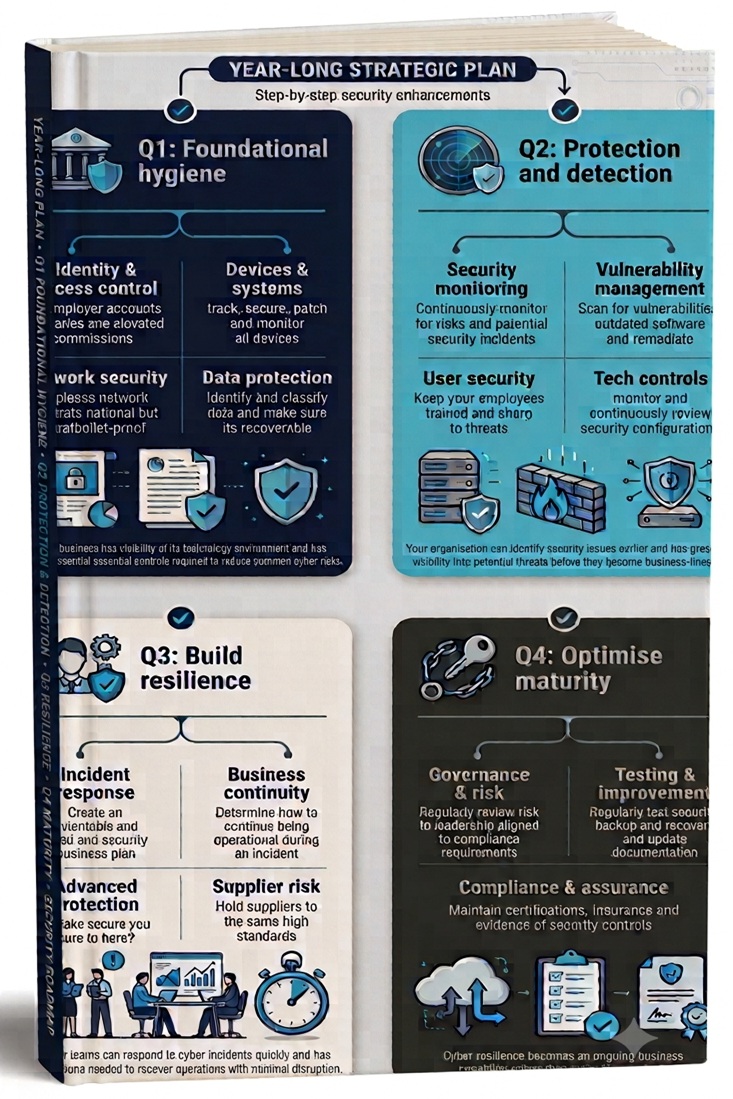
Not sure how to get started?
The businesses that thrive are not necessarily the organisations with the largest IT budgets.
They are the organisations that build strong foundations, understand their risks, prepare for disruption and continuously improve their resilience.
Cyber Essentials provides the starting point. Cyber resilience ensures your business can continue operating when disruption occurs. NIS2 provides a useful blueprint for where cyber maturity is heading.
Organisations that start building resilience today will be better positioned to satisfy customer requirements, improve operational stability and reduce risk tomorrow.
Whether you’re starting with Cyber Essentials, reviewing supplier requirements or preparing for future cyber resilience obligations, XC360 can help you build a practical roadmap aligned to your business goals.
Your hub for sharp IT insights, practical advice, and expert guidance. From IT strategy and support to cybersecurity and cloud technology, this is where you stay ahead. At XC360 we go beyond traditional support, helping you stay future‑ready, solve problems fast, and strengthen your IT confidently.








Got a question? Ask here